

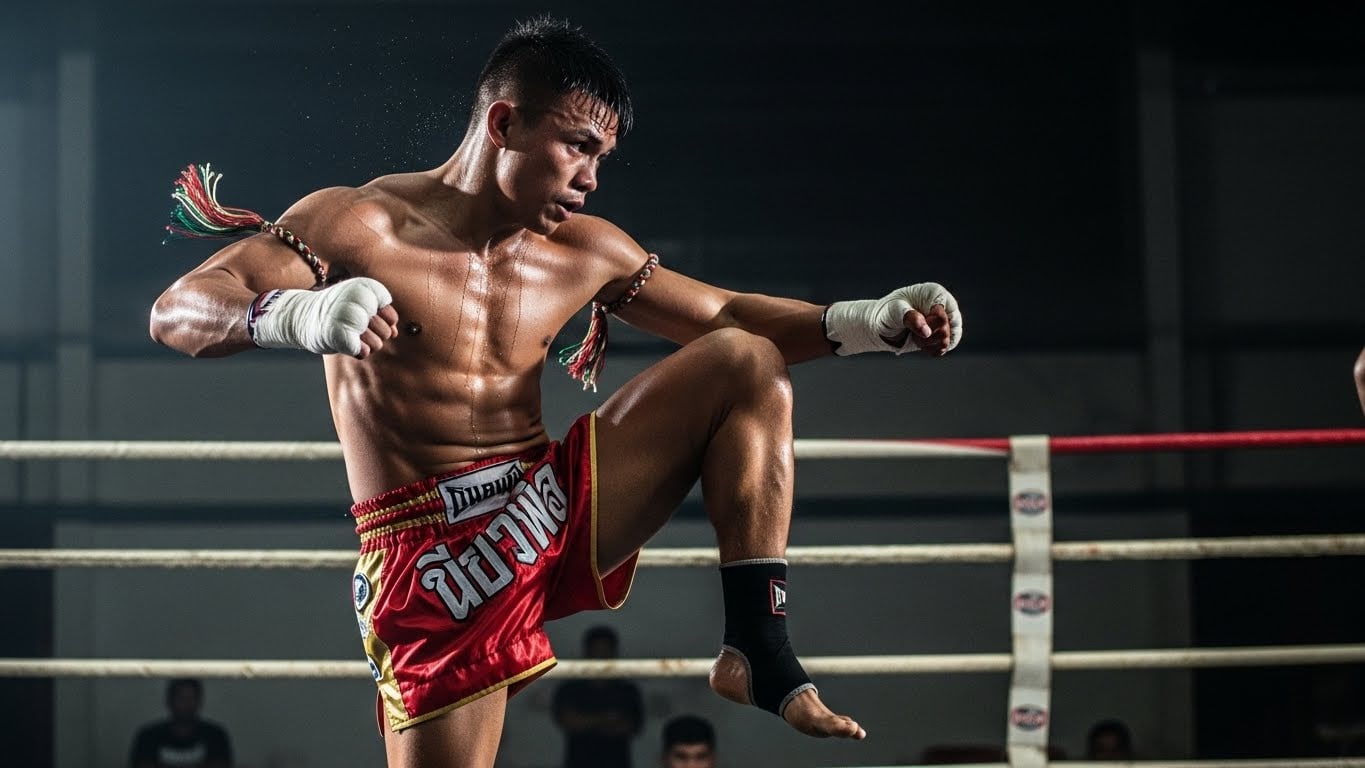
Combat sports evolve quickly when popularity outpaces structure. Rules are simplified, pacing is altered, and technique is often sacrificed for spectacle. One reason muay thai has retained such a distinct technical identity is the continued importance of stadium competition, where scoring systems, officiating standards, and tradition work together to preserve how the sport is meant to be practiced at elite level.
Rather than freezing the sport in time, stadium bouts act as a reference point, anchoring evolution to clearly defined principles.
Technique Is Protected by How Fights Are Scored
Unlike many striking sports, Muay Thai does not reward activity alone. Balance, control, and effectiveness determine who is winning a round. Stadium scoring prioritises clean technique, visible impact, and dominance in the clinch over volume or aggression without consequence.
This system discourages reckless exchanges. Fighters are incentivised to demonstrate mastery rather than chase knockouts at any cost. Over time, this preserves the importance of posture, timing, and composure, qualities that are easily lost when scoring becomes damage-only or entertainment-led.
Clinch Work Remains Central, Not Optional
In many global adaptations of the sport, clinch fighting is reduced or broken quickly to maintain pace. Stadium competition resists this shift. Clinch control, knee placement, and balance manipulation remain critical scoring elements.
By allowing clinch exchanges to develop, stadium bouts protect a core technical pillar of Muay Thai. Fighters must train positioning, patience, and endurance, ensuring that clinch skill does not disappear from the sport’s highest level.
Ritual Reinforces Discipline, Not Performance
Pre-fight rituals are sometimes misunderstood as theatrical additions. In stadium competition, they function as a reminder of discipline and respect. Wai kru and ram muay establish tone, slow the pace, and signal that the contest is about control as much as confrontation.
This framing influences behaviour inside the ring. Fighters approach early rounds with calculation rather than chaos, preserving traditional pacing and strategic buildup across five rounds.
Officials Act as Guardians of the Rule Set
Referees and judges in stadium environments are trained within a shared framework. Their consistency reinforces what techniques matter and which behaviours are discouraged. Excessive forward pressure without balance, sloppy punching, or uncontrolled aggression rarely score well.
This officiating culture shapes how fighters train. Gyms preparing athletes for stadium competition prioritise fundamentals because they know shortcuts are unlikely to be rewarded on fight night.
Five Rounds Still Matter
Many modern fight formats compress contests into shorter bouts to increase intensity. Stadium Muay Thai maintains the five-round structure, which demands conditioning, tactical awareness, and adaptability.
This format encourages fighters to manage energy, read opponents, and adjust strategy over time. It preserves Muay Thai as a thinking sport, not just a physical one.
Why This Matters Beyond the Stadium
Stadium competition influences how Muay Thai is taught globally. Techniques validated at elite level filter down into gyms, coaching systems, and international competition. Without a clear technical benchmark, the sport would fragment into incompatible interpretations.
By maintaining strict standards, stadium bouts ensure that innovation happens within a shared language rather than replacing it entirely.
Tradition as a Living System
Preservation does not mean resistance to change. Equipment, training methods, and athlete preparation continue to evolve. What remains stable is the framework that determines what “good Muay Thai” looks like under pressure.
Stadium competition provides that framework. It allows the sport to grow without losing its core identity, ensuring that technique, balance, and intelligence remain central to victory.
In a global combat sports landscape driven increasingly by spectacle, Muay Thai’s stadium system stands out for a different reason. It protects the foundations that make the sport recognisable, disciplined, and technically rich, not by restricting evolution, but by guiding it.
 Headlines Team
  Daniel