

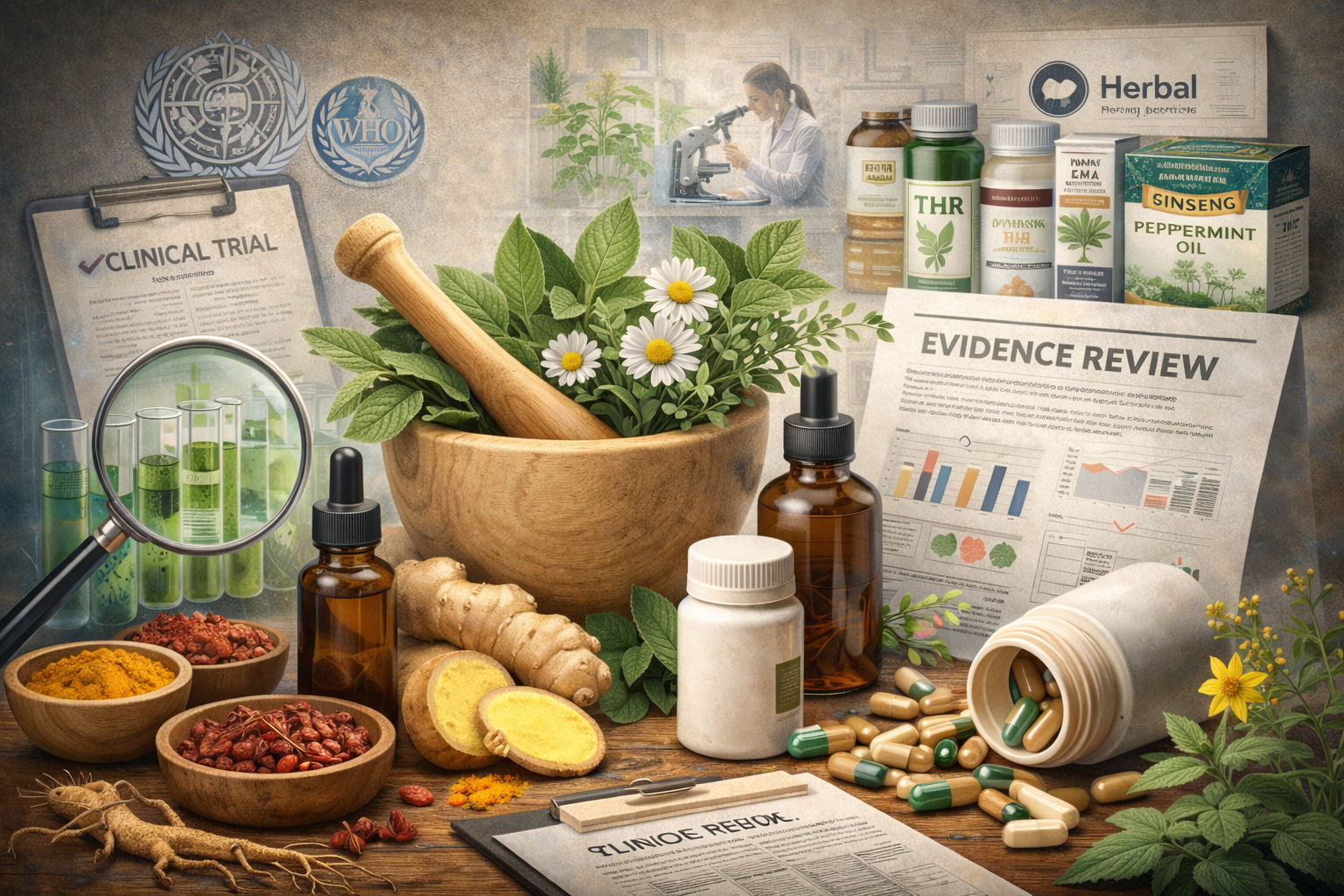
Traditional herbalism is having a modern moment. It shows up in boutique clinics and mainstream pharmacies, in wellness newsletters and public health debates, and in the product aisle that used to be mostly vitamins. What changed is not that people suddenly discovered plants. What changed is how plants are packaged, marketed, regulated, and studied.
This is why the conversation has shifted from folklore versus medicine into a more practical question. Which remedies have enough real-world and clinical support to be called evidence-based herbal remedies, and which ones are being carried mostly by hype?
The answer is not a simple yes or no. It depends on what you mean by evidence, how the product is made, and what outcome you are measuring.
A global push toward evidence and safety
One reason herbalism is being taken more seriously is that global health institutions are treating it as part of the health system reality. The World Health Organization has a Global Traditional Medicine Strategy for 2025 to 2034 that repeatedly emphasizes evidence, safety, quality, and regulation as the basis for integrating traditional, complementary, and integrative medicine.
That framing matters. It signals an era where traditional use alone is no longer treated as enough. The expectation is moving toward structured research, clearer standards, and better oversight.
Not all herbal products are the same
A major source of public confusion is that herbs appear in multiple product categories that do not follow the same rules.
Some products are regulated as herbal medicinal products in certain regions. In the European Union, the European Medicines Agency Committee on Herbal Medicinal Products develops monographs that describe uses and safe conditions for specific herbal substances and preparations.
In the United Kingdom, many herbal medicines can carry a Traditional Herbal Registration marking, which is intended to indicate compliance with quality and safety standards for manufacturing and product information.
In the United States, many herbal products are sold as dietary supplements. The Food and Drug Administration describes how manufacturers are responsible for ensuring products are not adulterated or misbranded before marketing, within the supplement framework.
Those differences shape what evidence you can realistically expect and what kinds of safety checks are more likely to exist.
What counts as evidence in herbalism
When people say evidence-based herbal remedies, they often imagine one gold standard, like a large randomized trial. Herbalism rarely fits that neat box because the product is not always a single molecule, and the supply chain is not always consistent.
In practice, evidence tends to come from three layers.
Traditional use evidence
This is long long-standing use with documented patterns of preparation and purpose. It can support plausibility and guide research, but it does not prove effectiveness by itself.
Clinical trial evidence
This can include randomized controlled trials. In herbal products, quality can vary depending on whether the trial used a standardized extract and whether outcomes were clinically meaningful.
Systematic review evidence
This is where the field becomes more usable for policy and practice, because it aggregates results across trials and highlights where effects are consistent and where they are not.
The trend right now is that regulators and health systems want more of the second and third layers, plus stronger quality controls.
Three examples where the evidence is often discussed
To keep this grounded, here are three areas where research is commonly cited, with the important caveat that outcomes depend on product quality, dose, and individual factors.
Peppermint oil and irritable bowel syndrome
A 2022 meta-analysis reported peppermint oil performed better than placebo for irritable bowel syndrome symptoms, while also noting more adverse events and very low quality of evidence, with a need for better trials.
This is a good example of a remedy that is not pure folklore, but also not a settled medical certainty.
St John’s wort and mild to moderate depression
A 2024 evidence summary from the National Center for Biotechnology Information notes some St John’s wort products can relieve mild to moderate depression in the short term, while emphasizing drug interactions and limits in severe depression evidence.
This is also a classic example of why evidence-based herbal remedies still require safety thinking, because interactions can be clinically significant.
Ginger and nausea
The National Center for Complementary and Integrative Health maintains a ginger fact sheet focused on what science says and safety considerations, reflecting the way herbs can sit in a middle zone between culinary use and supplement claims.
These examples show the modern pattern. Some herbs have a signal, but the signal is conditional.
The modern risk is not just bad advice; it is bad products
The strongest critique of herbal supplements today is not only that evidence can be thin. It is that product quality can be unpredictable.
Two recurring issues are contamination and adulteration.
Contamination can mean heavy metals or other toxins. In December 2025, the US Food and Drug Administration warned about heavy metal poisoning linked to certain unapproved Ayurvedic drug products after testing found high levels of lead and mercury, plus arsenic and other toxic substances in a product sample.
It can also mean contamination events that trigger recalls. In March 2025, the FDA published a recall notice for specific Zaarah Herbals products due to potential elevated lead and arsenic contamination.
Adulteration is a different problem. Some products are found to contain undeclared medicines. A July 2024 public notice from Hong Kong’s drug office described a product that was found to be tainted with multiple undeclared medicines not listed on the label.
NCCIH also flags safety concerns that include drug interactions and contamination with active pharmaceutical agents, and reminds readers that herbs can carry the same dangers as other pharmacologically active compounds.
Regulation is starting to treat herbal claims more seriously
The policy trend is moving in two directions at the same time.
One direction is integration with guardrails. That is what you see in the European model, where herbal medicinal products can be supported by monographs and defined conditions of use.
The other direction is enforcement against fraud. The US FDA maintains a Health Fraud Product Database listing products cited in warning letters, recalls, and related actions for issues like disease claims and undeclared ingredients.
This combination tells you where the industry is going. The market may grow, but the tolerance for vague claims and unsafe manufacturing is shrinking.
The influencer layer changed the herbalism market
Another reason herbalism looks different today is that discovery happens online. A recommendation can go viral before the evidence catches up. This creates a new feedback loop.
A trending herb becomes a product boom
The boom funds more marketing and more creators
Consumers interpret popularity as proof
Clinicians see new side effects and interactions in practice
Researchers and regulators play catch-up
This is where large-scale health educators have influence. Dr. Berg is one example of a major online educator whose content often intersects with natural health topics, and audiences frequently treat that style of education as a shortcut to decision-making. That influence can be helpful when it pushes people toward better habits, and risky when people treat generalized content as personal medical guidance.

What a modern evidence-based approach looks like
If you are trying to use evidence-based herbal remedies without getting pulled into marketing, it helps to apply a simple filter.
Ask what the product is, not just what the plant is
Different extracts of the same herb can behave differently.
Ask what outcome is being claimed
Pain relief, mood, nausea, sleep, and blood sugar are not interchangeable claims.
Ask what the best human evidence says
Look for systematic reviews and evidence summaries, not only testimonials.
Ask about interactions
St John’s wort is a common example where interactions can matter a lot.
Ask about quality signals
In some regions, registrations and monographs can offer more structure for claims and safe use conditions.
Ask whether the risk is worth the benefit
A mild benefit with a serious interaction risk is not a win.
This is the mindset shift that separates modern herbalism from old school herbalism. It is less about belief and more about probability management.
The direction of travel
Traditional herbalism is not disappearing. If anything, it is becoming more institutional.
The key trend is standardization. Evidence expectations are rising. Quality expectations are rising. Regulators are building frameworks for safe integration, while also strengthening enforcement against fraud and contamination.
That means the next era of herbalism will likely look less like a folklore revival and more like a split market.
One lane will be evidence-oriented products with clearer standards and more transparent claims.
The other lane will be the high marketing supplement lane, where claims run ahead of oversight and where enforcement actions will keep surfacing.
The best outcome for the public is not to ban traditional remedies or to worship them. The best outcome is to make it easier to identify evidence-based herbal remedies that are made well, studied well, and used with a realistic understanding of both benefits and risks.
 Daniel