

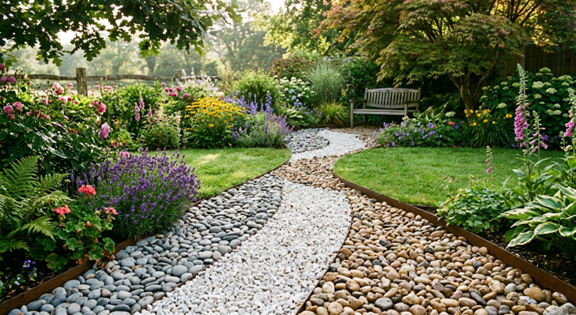
Decorative aggregates have become one of the greatest tools a landscaper or builder has when designing a home, office building, garden or other outside space. While aggregates were once viewed as a finishing detail, decorative stones and gravels now appear everywhere, making spaces look modern and complete. There are numerous benefits to this approach, with visual appeal being only one, and a simple walk around any city centre or business park will show you that many businesses and commercial property owners have realised the benefits of decorative aggregates either replacing or accompanying traditional lawns.
Outdoor spaces have always been viewed as highly important, and that shows no signs of change. The front-facing exterior of a building – be it domestic, governmental or commercial – really sets a first impression. You might be deterred from doing business with a company that has an unkempt, patchy lawn out the front of their head offices in the same way that you might not want to knock on the door of someone whose front lawn looks neglected. Equally, any outdoor spaces that are not viewable from the street inherently have a more intimate and integral feel, so when these spaces look bad it reflects even more strongly on the owner.
One of the primary benefits of decorative aggregates is the simple visual appeal. All manner of shades and tones are available, and each creates its own vibe, especially when used contrastingly. Lawns come in one colour – green – but an arrangement of aggregates can contain greys, blues, blacks, reds and far more, they inherently look more intentional and modern. Equally they can be used in more private spaces to create more warmth and intimacy, using warm creams, terracotta or mixed colours can create a Mediterranean garden feeling, for example, or uses of limestone and dolomite pebbles create a bright, calm feeling.
It is worth remembering that aggregates need not replace lawns and other greenery entirely. A well organised arrangement of different decorative stones with accompanying flowerbed borders, for instance, looks natural and beautiful, and the more monochromatic colouring of aggregates making any flowers even more visually striking due to the contrast. This leads into another huge benefit, decorative aggregates are becoming more important thanks to their role in sustainable drainage. Urban development has increased pressure on an aged drainage infrastructure, particularly in areas with large amounts of impermeable paving, meaning that lawns and other outside spaces can easily become water-logged and overload nearby drains. Decorative gravel and permeable aggregate systems can help rainwater infiltrate naturally, drastically reducing this. This can reduce surface water runoff and support more environmentally responsible landscaping strategies.
Decorative stone products, as supplied by mainlandaggregates.co.uk can form part of what the government and other organisations refer to as ‘Sustainable Drainage Systems’, often shortened to ‘SuDS’. The idea is to create systems that require little to no maintenance whilst also having minimal environmental impact. As explained by Susdrain “SuDS mimic nature and typically manage rainfall close to where it falls. SuDS can be designed to transport (convey) surface water, slow runoff down (attenuate) before it enters watercourses, they provide areas to store water in natural contours and can be used to allow water to soak (infiltrate) into the ground or evaporated from surface water and lost or transpired from vegetation (known as evapotranspiration)”.
Versatility is another core aspect of their popularity. Different colours, textures and stone sizes allow designers to create traditional, contemporary or natural-looking landscapes depending on the style of the property. Light-coloured aggregates can create a clean modern appearance, while darker stones may provide contrast alongside planting, timber or brickwork.
Decorative stone arrangements are also highly durable. They can withstand heavy rain, high winds and regular foot traffic while retaining their appearance over long periods of time. With suitable edging and sub-base preparation, aggregates remain stable and attractive for many years.
Decorative aggregates can also contribute positively to biodiversity and planting performance. Gravel mulch may help retain moisture around plants, reduce soil erosion and suppress weed growth. In drought-tolerant or Mediterranean-inspired planting schemes, aggregates create a visually cohesive and practical landscape surface.
Another significant advantage is their flexibility in landscaping projects. Because they are relatively simple to install and refresh, decorative aggregates are particularly useful for retrofit schemes where budgets or site access may be limited. They can also be moved, replenished and reused with relative ease, making them a practical long-term solution.
Commercial developments and public spaces are also using decorative aggregates more frequently as part of wider sustainability-focused landscape strategies. Rain gardens, permeable surfaces and integrated drainage features often incorporate stone and gravel to combine practical water management with visual quality.
The growing demand for outdoor living spaces has further increased the use of decorative aggregates. Homeowners increasingly want gardens and patios that feel designed, adaptable and easy to maintain. Gravel pathways, seating areas and decorative borders can help create outdoor environments that are functional throughout the year.
All manner of outdoor spaces, such as the front exterior of offices, homes, government buildings or even public parks and more all benefit in a variety of ways from decorative aggregates. They are visually striking, durable, versatile and long-lasting whilst also aiding with drainage, biodiversity and protecting plants from the elements. For all these reasons and more, decorative aggregates will only continue to grow in popularity and importance.
 Headlines Team
  Daniel