

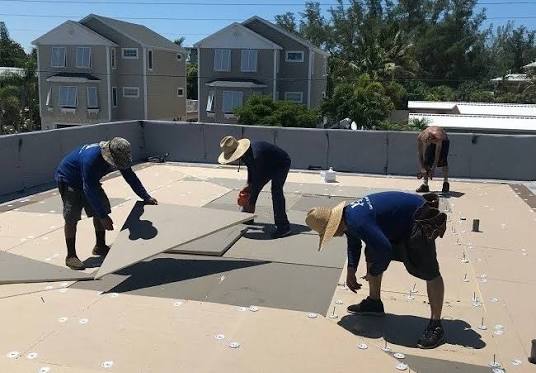
The membrane is rarely what fails. A flat roof that leaks in year eight of a twenty year rating usually gave out at the details, the slope, the fastening pattern, the seam welds and the flashing at the parapet, and every one of those was a decision an installer made on a Tuesday morning rather than a property the material carried out of the factory. Sit down with an experienced flat roofing contractor seattle wa building owners actually rehire, and the conversation moves to taper and welds within about four minutes. Underwriting a roof means underwriting that work, not the datasheet.
Spec Sheet Years Are Lab Years Not Roof Years
A twenty year rating comes out of accelerated weathering, where a coupon of membrane sits under controlled heat and UV cycling with no ponding water, no HVAC tech dragging a toolbox across it, and no fastener backing out underneath. Real roofs get all of that. Manufacturers are reasonably honest about the gap in their own literature, since most warranties turn on drainage that clears within 48 hours. Job after job, what turns up under an eight year failure is standing water sitting over a seam, not a membrane that simply wore out.
How much flat roof failure is installation versus material, I genuinely cannot tell you. Nobody publishes a clean split, and the two parties who could, manufacturers and installers, each have a reason to point across the table. My own read is that installation dominates, but I am reading job sites rather than a dataset, and I will not pretend that is the same thing.
Taper Design Decides Whether Water Leaves
Flat roofs are not flat. A properly specified system carries a quarter inch per foot of fall built out of tapered insulation, with crickets between drains so water gets pushed toward an outlet instead of parking in a low spot behind a curb. Water does not read the datasheet. It goes where the slope sends it, and when the slope sends it nowhere, it sits until it finds a fastener head or an unwelded lap.
Ask to see the taper plan drawing. A bid that has one shows a page of shaded triangles with drain locations marked, and a bid that does not just lists insulation by the board.
Fastener Density Gets Trimmed Quietly
Wind uplift is not uniform across a roof. Corners and perimeters need more fasteners per board than the field does, and that pattern comes from the manufacturer’s system approval for the wind zone, not from whatever fits the labor hours somebody quoted. Cost pressure on that math is real right now. In July 2026, a survey of roofing contractors reported that 74 percent had seen material suppliers raise prices since March 2026, with the reported increases averaging 6.7 percent over those four months. When margins compress, the trims land where nobody can inspect them afterward, and fastener count is the easiest place on a flat roof to find a few hundred dollars.
Seam Welds Are Tested Not Assumed
On TPO and PVC, the seams are hot air welded, and a weld that looks perfect from six feet up can still be cold underneath. The test is mechanical. A crew member walks every lap with a blunt seam probe and pulls, anything that opens gets rewelded, and the repaired section gets probed again before the crew moves on. A flat roofing contractor Seattle WA owners rehire will describe that walk without being prompted and will tell you it gets documented by area. If the answer is instead that the welder has twenty years of experience, that is not a test, that is a resume.
The Per Unit Math Across A Hold Period
Take a 12-unit 1970s walk-up held on a seven year plan. Say roof capex went into the model at $1,450 a unit, which reserves $17,400 across the hold on the assumption the existing membrane lasts the whole period. The deck runs roughly 5,200 square feet, and a tear-off with tapered polyiso and a mechanically fastened membrane prices somewhere near $13 a square foot in this market, call it $67,600. Subtract the reserve and that leaves $50,200 nobody modelled, which comes to about $4,180 a unit, arriving in the exact year the refinance was supposed to happen. Those figures are an illustration rather than a quote, but the shape of the problem is not.
Underwrite The Installer Not The Membrane
Before the bids arrive, pull the address up on Seattle’s Shaping Seattle Permits map, which is free to anyone, and see whether the last reroof was ever permitted. An unpermitted overlay in 2011 explains a great deal about a failure in 2026. Then read the competing bids side by side for four lines specifically: the taper plan, the fastening pattern by zone, who probes the welds, and a craftsmanship warranty that covers labor separately from the manufacturer’s material coverage. The building that actually delivers its underwritten service life is the one where somebody made those four answers a condition of signing, not the one that bought the longer number on the front page.
 Headlines Team