

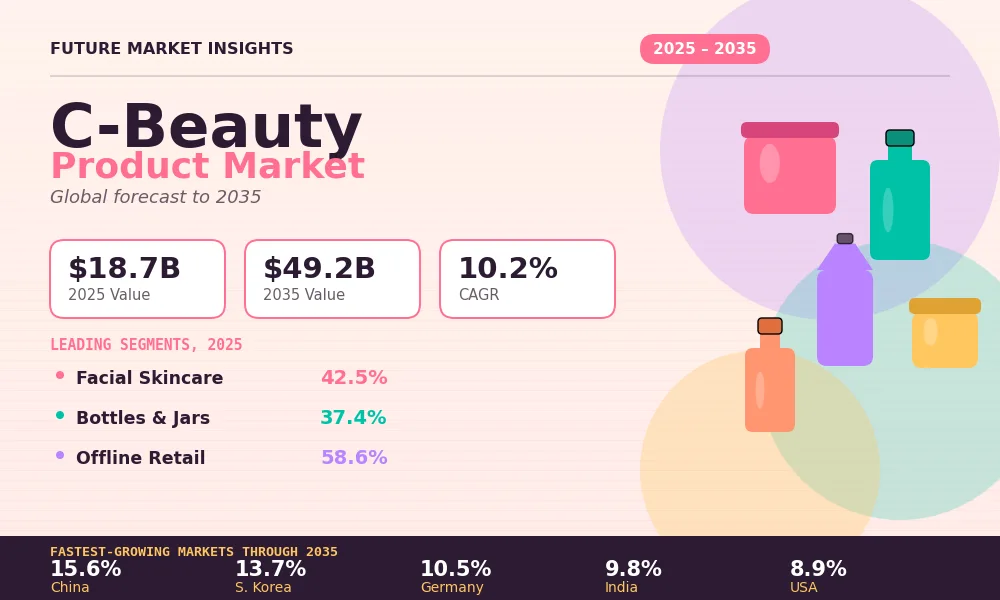
Chinese beauty brands are moving from domestic dominance to global shelf space, with skincare, herbal formulations, and livestream commerce driving a market expected to grow at 10.2% CAGR through 2035, according to new research from Future Market Insights.
Pune, India — The global C-beauty product market, valued at USD 18.7 billion in 2025, is projected to reach USD 49.2 billion by 2035, expanding at a compound annual growth rate (CAGR) of 10.2%, according to a new report from Future Market Insights (FMI). The forecast implies an absolute dollar opportunity of USD 30.5 billion over the decade — a 2.63x increase in market size, with 2024 sales already estimated at USD 16.9 billion.
A Category Outgrowing Its Domestic Base
C-beauty — shorthand for Chinese-origin cosmetics and personal care products — has historically been treated as a regional story. The report’s framing suggests that read is increasingly outdated. It places the category at roughly 20% of the global beauty and personal care market and close to 15% of the global cosmetics and toiletries market, driven not by novelty but by a specific value proposition: affordability paired with herbal and Traditional Chinese Medicine (TCM)-derived ingredients that Western and Southeast Asian consumers increasingly recognize by name.
For brand executives and investors evaluating where to compete next, the more instructive number may be the growth curve’s shape. The first half of the forecast period (2025-2030) is expected to add roughly USD 11.6 billion — about 38% of total decade growth — while the second half (2030-2035) contributes an estimated USD 18.9 billion, or 62%. That acceleration is attributed to deeper cross-border retail integration and C-beauty brands moving from niche e-commerce listings into mainstream pharmacy, luxury, and specialty retail formats. In practical terms: the harder distribution work happening now is expected to compound later in the decade, which has implications for how partners and investors should time entry.
Facial Skincare and Herbal Ingredients Anchor the Category
By product type, facial skincare leads with 42.5% of global revenue in 2025, driven by the layering-heavy routines — cleansers, toners, serums, creams — that are characteristic of Chinese skincare culture and increasingly adopted elsewhere. By packaging, bottles and jars hold 37.4% share, reflecting consumer priorities around hygiene and product preservation for both daytime serums and nighttime creams.
Ingredient sourcing is where the category’s differentiation is sharpest: herbal and TCM-based formulations account for 28.5% of product use globally, built around ingredients like ginseng, licorice root, peony, and angelica that carry cultural credibility Western clean-beauty brands have struggled to replicate authentically. Distribution still skews offline, with 58.6% of global sales running through physical retail — a reminder that trial and in-store demonstration remain important trust-building mechanisms for brands with limited existing name recognition outside China.
Growth Is Not Evenly Distributed — and That Matters for Market Entry
The country-level data offers a clear read on where near-term investment is likely to pay off fastest. China itself leads at a 15.6% CAGR through 2035, unsurprising given domestic brand dominance and deep social-commerce integration through platforms like Douyin. More notable for global operators: South Korea follows at 13.7%, a market where Chinese-origin formulations are gaining share as younger consumers look past established J-beauty and K-beauty labels toward minimalist, ingredient-transparent alternatives.
Germany, at 10.5%, slightly outpaces the global average — evidence that European retail (dm-drogerie markt, Flaconi are named distribution partners in the report) is proving more receptive to Chinese skincare than conventional wisdom might suggest. India, at 9.8%, sits just under the global rate, with platforms like Nykaa and Tira already carrying C-beauty brands positioned on affordability and social-media-driven discovery. The United States lags the group at 8.9%, which the report attributes to distribution barriers and lingering brand-perception challenges — a signal that market entry there likely requires more deliberate positioning work than in Asia-Pacific or Europe.
What’s Working, and Where the Friction Is
Beyond the headline numbers, the report flags operational patterns worth attention from anyone building or evaluating a C-beauty go-to-market strategy. E-commerce and short-form video are doing outsized work: more than half of category revenue in 2024 ran through digital flash sales and video-driven campaigns, and interactive shopping formats have been linked to meaningfully larger basket sizes.
The friction points are equally instructive. Refund rates run higher in markets where certification or labeling isn’t clear, and repeat-purchase rates in North America and Europe trail Southeast Asia by a wide margin — pointing to a trust gap that’s more about compliance and communication than product quality. Regional bundling and festival-timed launches, by contrast, have shown measurable lift in conversion across Latin America and South Asia, suggesting that localization strategy matters as much as the underlying formulation.
Competitive Landscape Remains Fragmented at the Top
The report describes the competitive field as anchored by a handful of scaled players — Yatsen Holding (parent of Perfect Diary), Proya Cosmetics, and Chando Group among them — alongside ingredient-focused specialists like Winona and Herborist building around TCM positioning. Emerging entrants such as Colorkey and ZEESEA are competing primarily through packaging design and short-video marketing rather than legacy retail relationships, which the report suggests is reshaping what “competitive advantage” means in the category: increasingly a function of content and digital distribution rather than shelf space alone.
For manufacturers, brand owners, and investors assessing this market, the report’s full segmentation — spanning product type, packaging, ingredient base, sales channel, and more than 40 country profiles — is built to support decisions on where to enter, which retail formats to prioritize, and how quickly to scale.
About the Research: This analysis is based on the “C-Beauty Product Market” report published by Future Market Insights (FMI), a market research and consulting firm. The full report, including detailed segment and country-level forecasts, is available at futuremarketinsights.com.
Explore the full findings:
- 📄 Request a Free Sample Report — preview methodology, segment breakdowns, and select data tables before purchase.
- 📊 View the Complete C-Beauty Product Market Report — full 250-page analysis covering product type, packaging, ingredient base, sales channel, and 40+ country profiles through 2035.
Frequently Asked Questions
How big is the C-beauty product market in 2025? The global C-beauty product market is valued at approximately USD 18.7 billion in 2025, up from an estimated USD 16.9 billion in 2024.
How large will the C-beauty product market be by 2035? The market is projected to reach USD 49.2 billion by 2035, growing at a 10.2% CAGR — an absolute dollar opportunity of USD 30.5 billion over the decade.
Which product segment leads the market? Facial skincare leads by product type, holding a 42.5% share in 2025, driven by multi-step cleansing, toning, and serum routines.
Which country is growing fastest? China leads all major markets at a 15.6% CAGR through 2035, followed by South Korea at 13.7% and Germany at 10.5%.
Who are the leading players in the C-beauty product market? Yatsen Holding (parent of Perfect Diary) is a leading player through cross-border expansion, alongside Proya Cosmetics, Chando Group, Winona, and Herborist.