

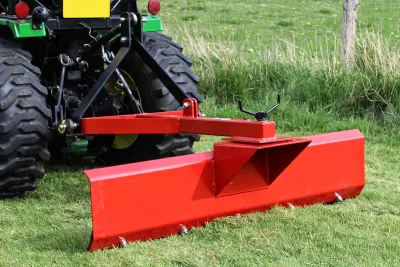
The truck yard sits on four acres outside Kansas City, leased to two tenants, and from the road it looks fine. Walk it in March and the story changes, because the thaw exposes two ruts running the length of the drive lane, a soft spot by the gate where a loaded trailer parked all winter, and a service contractor proposing to fix all of it with a worn grader blade and another invoice. That invoice is $1,100 this month. It was $960 last spring. Nobody in the chain can tell the owner what actually changed.
State the argument plainly: on a small unpaved industrial property, owning a properly hardened cutting edge for the tractor already sitting on site turns an open-ended maintenance line into a fixed one you can budget a year in advance. The work does not disappear. The billing model does. The yard tells you the truth long before the invoice does, and a twenty-minute walk is what turns a vague suspicion about scope creep into three specific questions the contractor has to answer in writing.
Walk The Yard Before You Approve Another Invoice
Start at the gate and follow the traffic pattern the trailers actually use, not the one drawn on the site plan. Look for ruts deeper than about two inches, standing water with nowhere to go, and gravel pushed into windrows along the edges where a blade has been dragging material off the surface instead of cutting and redistributing it. That last one matters more than it sounds. Material shoved to the shoulder is material you already paid for and no longer have, which is why the same yard needs fresh rock every eighteen months while the service invoice climbs. Check the crown next. If the middle of the drive lane is flat or dished, water sits, the base softens, and the potholes come back within weeks of every visit. Photograph the four worst spots with a tape measure in the frame.
Part of the annual increase is real market inflation and part of it is scope, and an owner who cannot separate the two will keep approving both. FRED, the free database the St. Louis Fed publishes, settles the first half in about a minute: pull the producer price index for nonresidential building maintenance and repair and read what the market did on its own. What usually turns up on properties this size is an index moving a few points a year against an invoice moving several times faster. The gap is scope, and scope is negotiable.
Against that backdrop, a jump from $960 to $1,100 in twelve months is not the market. It is roughly fourteen percent on a line the index says moved about two. Ask for the difference in writing (I asked twice before anyone would put a number on paper, which was informative by itself). A contractor who can explain it usually has a real reason, like a wetter spring or a new tenant running heavier axle loads across the same lane every morning.
Owner Questions About Unpaved Yard Upkeep
Three questions come up on nearly every call with a small industrial owner in this position. None of them have complicated answers. They just have answers that nobody volunteers while the contract is being renewed.
How Often Does A Gravel Truck Yard Really Need Grading?
For four acres carrying daily trailer traffic, twice a year plus one pass after the spring thaw covers most conditions. Monthly service on a yard that size is usually a symptom of poor drainage or an edge that is no longer cutting, not a genuine need. If someone is out every four weeks, fix the water first and the frequency tends to fall on its own.
Is It Cheaper To Just Pave The Yard Instead?
Almost never at this scale. Paving four acres to a spec that survives loaded trailers is a capital project with a six-figure number in front of it, and tenants leasing an unpaved outparcel are paying unpaved rent. Maintained gravel costs a fraction of that, and pinning down the fraction is the whole exercise.
Can My Tenant’s Own Tractor Handle This Work?
Often yes, if the tenant already runs a compact tractor or skid steer with a box blade for snow. The machine is rarely the constraint. The cutting edge bolted to it is, because a rounded, worn edge skids over high spots instead of shearing them, and the same pass that used to smear material will actually cut it once the edge is sharp and correctly beveled.
Own The Blade And Cap The Line Item
Here is the arithmetic on the Kansas City yard, using illustrative figures you can swap for your own. Say a set of single-bevel edges sized for the tenant’s box blade runs $700, and say two hours of tenant labor twice a year is worth $300 credited against rent. That is $1,000 in year one and about $300 a year after that, set against $13,200 of annual service billing at the current rate. Keep the contractor for the thaw pass and the occasional gravel delivery if you want, and the recurring line still stops being open-ended. An edge is a part with a known price and a known wear life, and a part is something a budget can actually hold.
The one place not to chase the lowest number is the edge itself. Hardness and bevel geometry decide whether it cuts for two seasons or rounds off in four months, and both are set during fabrication rather than at the loading dock. A May 2026 analysis from Therness put rework on heavy fabrication components at 3 to 5 times the cost of the original operation, with true weld defect costs reaching 10 to 50 times the value of the original joint. Those multiples are why a fabricator that verifies dimensions and inspects during production, not only at the end, earns its premium on a wear part. You are not really buying steel here. You are buying the number of hours it holds an edge under a loaded machine.
So walk the yard, photograph the ruts, pull the index, and ask what changed. Then price a grader blade for the machine already parked on the property and hold it against twelve more months of invoices nobody will itemize. Some owners will look at that comparison and still hire the work out, which is a perfectly defensible call when the property is three states away or the tenant will not touch equipment. The difference is that it becomes a choice with a number attached instead of a bill that quietly grows on its own every year.
 Headlines Team