

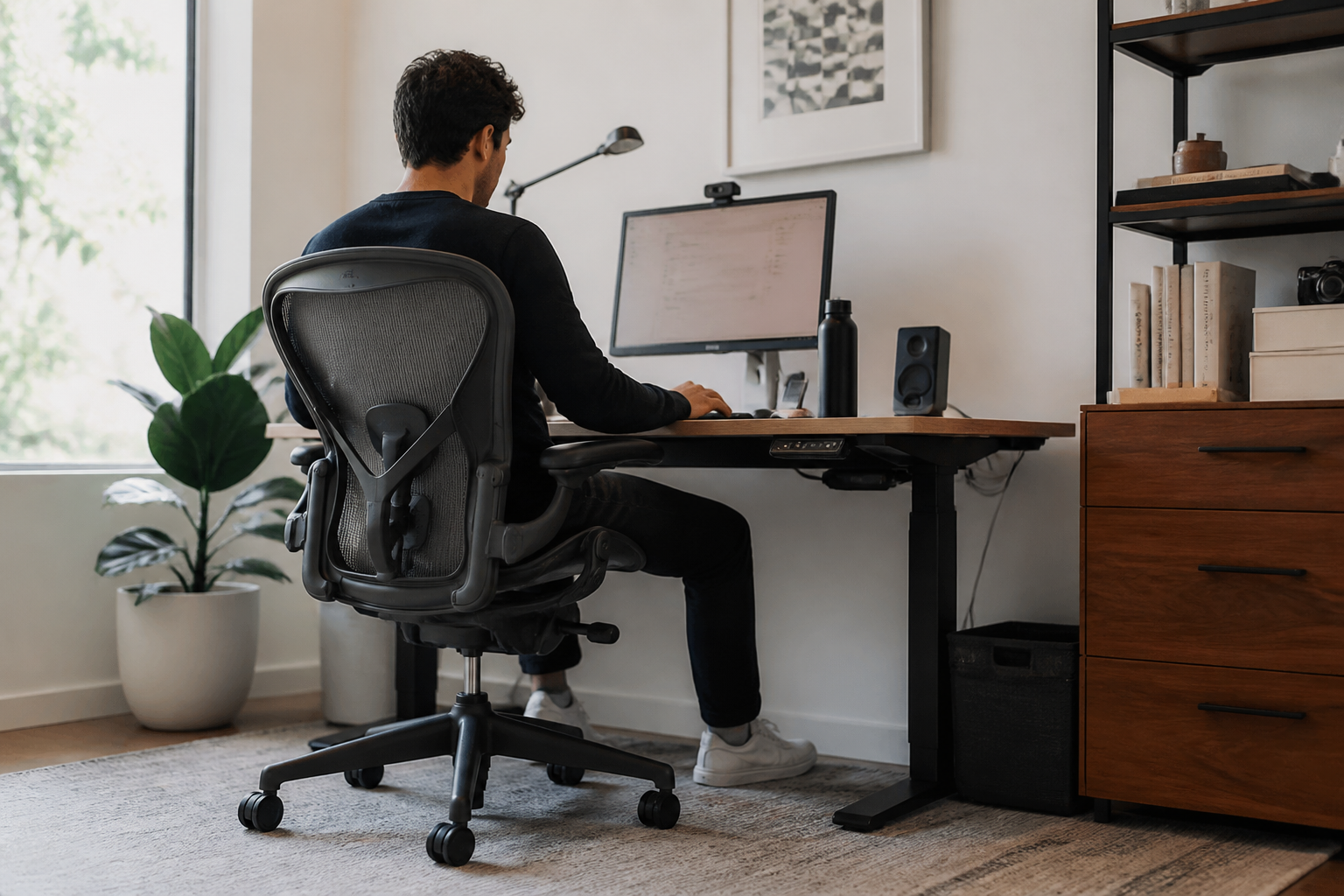
Key Takeaways
- Look past the word “ergonomic” on the tag — a real Herman Miller task chair adjusts to your body’s actual measurements (seat depth, pan angle, lumbar height), while most basic office chairs offer one-size-fits-none padding.
- PostureFit SL support targets your sacrum, not just your lower back, which matters if you’re dealing with chronic pain that flares up after two or three hours at a desk.
- Before choosing between the Aeron, Ergon 2, or Celle, match the model to your body type and pain pattern — mesh tension zones and seat width affect hip pressure differently across each design.
- A certified pre-owned Herman Miller task chair with a real warranty can deliver the same spinal support as new for a fraction of the cost — just verify authentication before you buy.
- Know how to spot a Herman Miller chair dupe: check for stamped model numbers, genuine Pellicle mesh, and dealer documentation, since knockoffs skip the pressure-mapped testing that protects your spine.
- If you sit 6 or more hours a day, a task chair built for movement and recline will do more for your neck, hips, and lower back than an executive chair built mostly for looks.
Ten years. That’s roughly how long a spine can spend absorbing the damage from the wrong chair before someone finally asks a physical therapist why the pain won’t quit. In 20 years of assessing office setups, one pattern never changes: the people who come in with chronic lower back pain or hip pressure are almost always sitting in a chair that was never built to hold a spine in a healthy position for eight hours straight. That’s the gap a herman miller task chair is engineered to close — not with padding, but with mechanics that respond to how your body actually moves.
Here’s what most people miss: not every chair marketed as “ergonomic” earns that word. A $250 mesh chair from a big-box store — a Herman Miller Aeron might look similar in a product photo, but the internal engineering — seat pan angle, lumbar mechanics, recline resistance tuned to body weight — isn’t even close. And in 2026, with more people splitting time between home offices and shared workspaces than ever, that difference matters more, not less.
So what actually separates a real task chair from a chair that just sits in the same category on a spec sheet? That’s worth breaking down piece by piece.
The Real Difference Between a Task Chair and a Basic Office Chair
Picture a claims adjuster who sits nine hours a day, shifting between typing, phone calls, and reaching for files. Her $180 chair from a big-box store feels fine for the first hour. By 3 p.m., her lower back aches and she’s propping a rolled towel behind her spine. That’s the gap a properly built herman miller task chair closes — not through cushioning alone, but through mechanisms that track how her body actually moves.
Why “Ergonomic” Doesn’t Mean the Same Thing on Every Tag
Plenty of chairs slap “ergonomic” on the tag with a fixed foam seat and one recline setting. Real support means independent seat depth, dynamic lumbar tracking, and a backrest that flexes with your spine instead of just tilting behind it.
Task Chair vs Executive Chair: Which One Actually Supports Your Spine
An executive chair prioritizes leather, height, and boardroom presence for someone sitting two or three hours a day. A task chair is engineered for the person logging eight-plus hours at a swivel base every single day — and for chronic pain, that distinction matters more than price or looks.
How Herman Miller Engineers Spinal Support Into Every Task Chair
Most desk chairs treat your back like an afterthought. A real herman miller task chair treats it like the whole point. The frame, the mesh tension, the recline pivot — every part gets built around how your spine actually moves, not how a factory wants to cut costs. That’s the split between a $150 box-store chair and something engineered to hold up for a decade of daily use.
PostureFit SL and the S-Curve Your Spine Needs
Your lower back isn’t flat — it curves inward at the sacrum. PostureFit SL uses two independent pads to cradle that curve directly, tilting your pelvis forward instead of letting it slide back into a slump. Basic chairs offer one flat lumbar bump. That’s not support. That’s a placeholder.
Seat Depth, Pan Angle, and Why Standard Chairs Get This Wrong
Seat depth that’s off by even an inch pushes pressure into the back of your knees, cutting circulation over a 7-hour workday. Adjustable seat pans let shorter and taller users both plant their feet flat with thighs level. Fixed-depth chairs simply can’t do this — one size fits nobody well.
Headrest Options and When Your Neck Actually Needs One
Not everyone needs one. But if you recline often or deal with forward head posture from screen work, a headrest keeps cervical strain from creeping in during longer sessions. Shoppers comparing herman miller task chair models should check headrest compatibility before buying, since not every configuration includes it standard.
Aeron, Ergon, Celle, Equa: Comparing Herman Miller Task Chair Models
Which mesh back actually fits your spine — and which one just looks the part? That’s the real question buyers face once they start comparing models, and the answer changes depending on body type, seat depth needs, and how many hours you log daily.
Herman Miller Aeron Chair — The Benchmark for Pressure Distribution
The Aeron remains the reference point for even weight distribution across the seat pan — back — its 8Z Pellicle mesh flexes in eight zones instead of collapsing into one flat plane like cheaper mesh copies. Three sizes cover a wide range of frames, which matters more than most shoppers realize.
Ergon 2 and Celle: Mesh Support for Different Body Types
The Ergon 2 leans firmer and more upright, good for people who want structure over give. Celle’s honeycomb-style back moves more freely, better suited to restless sitters who shift position constantly through the day.
Equa Chair and Vintage Herman Miller Models Still Worth Considering
Older Equa units and vintage builds still show up in the used market, and plenty still function well after two decades if the foam and gas cylinder were replaced. Given the ongoing debate over whether are herman miller task chairs worth it, the answer usually comes down to condition, not age.
Why Herman Miller Chairs Cost More Than Big-Box Office Seating
73% — that’s roughly the failure rate physical therapists report seeing in budget task chairs within 24 months of daily use. That number should stop anyone comparing a $250 mesh chair to a certified herman miller task chair side by side. Frame construction, gas cylinder grade, and mesh tension zones aren’t cosmetic upgrades. They’re the difference between a chair that holds your spine’s natural curve at year five versus one that sags by month eight.
Materials and Testing That Basic Chairs Skip
Herman Miller runs its frames through cyclic load testing that simulates over a decade of daily sitting and reclining. Big-box chairs rarely get tested past a few thousand cycles. Before buying, it helps to understand how to compare herman miller task chairs against generic alternatives on frame durability, not just price tags.
The Hidden Cost of Replacing a Cheap Chair Every Two Years
A $200 chair replaced three times over six years costs more than one certified chair built to last twelve. That’s before counting the chiropractor visits from a broken tilt mechanism nobody bothered to fix.
New, Pre-Owned, or Open Box: How to Buy a Herman Miller Task Chair Without Guessing
Here’s a myth worth busting: buying pre-owned or open-box means settling for damaged goods. That’s just not how it works anymore. A properly inspected herman miller task chair can perform identically to a brand-new one — the mechanisms, the mesh, the tilt tension, all of it — for a fraction of the original price.
What “Certified” and “Authentic” Actually Mean When Buying Pre-Owned
Authentic means the chair actually came off a Herman Miller production line, not a knockoff frame with swapped labels. Certified means someone physically tested the seat pan, casters, and recline mechanism before it shipped. Skip either step and you’re gambling on a used chair with unknown history.
Warranty Coverage on Refurbished Herman Miller Chairs
A real warranty is the difference between confidence and hope. If a seller won’t back a refurbished chair for years, not months, that tells you something about how much they trust their own restoration work.
Spotting a Herman Miller Chair Dupe Before You Buy
Check the base casting, the mesh weave pattern, and the recline sound — dupes cut corners in ways your spine will feel by week three. And here’s something worth checking before you commit: research on can a herman miller ergonomic chair cut back pain in 14 days shows real spinal support isn’t cosmetic — it’s mechanical.
Matching a Herman Miller Task Chair to Chronic Back, Neck, or Hip Pain
A client walks into a consult after eight hours a day in a $150 mesh chair from a big-box store, telling me her lower back locks up by 2 p.m. and her right hip goes numb by 4. That’s not a comfort problem — it’s a mechanical one. And the fix usually isn’t a cushion. It’s a chair built around how the spine actually moves.
Lower Back Pain and Sacral Support
The PostureFit SL system on the Aeron isn’t a lumbar pillow.
It’s two independent pads — one under the sacrum, one at the lumbar curve — that keep the pelvis tilted forward instead of collapsing backward. That single mechanism is why the Aeron outperforms most task chairs for disc-related pain.
Neck Strain, Headrests, and Upper Back Force Adjustment
Standard Aeron models skip a headrest, which works fine for forward-focused typing but not for anyone reclining frequently. An adjustable upper back force control — similar to what you’ll find on a Steelcase Leap — lets you dial in resistance so your neck isn’t fighting the recline on every lean-back.
Hip Pressure Points and Seat Material Choice
The 8Z Pellicle mesh spreads weight across eight tension zones instead of compressing under sit bones like foam does. For hip pain specifically, that’s often the difference-maker — not the price tag.
Executive Chairs, Eames Designs, and Where They Fit Beside a Task Chair
A task chair — an executive chair solve two different problems. One is built for the eight-hour grind at a keyboard. The other is built to look sharp in a director’s office and hold up for shorter meetings.
Eames Executive Chair vs Herman Miller Task Chair for Desk Work
The Eames executive chair — leather-wrapped, tilted back, low seat depth — was never engineered around the same body mechanics as a Herman Miller task chair. It leans on cushioned padding instead of dynamic lumbar tracking. A chairman sitting in one for a 20-minute call feels fine. A writer or developer sitting in one for six hours starts noticing hip pressure and a flattened lower back by mid-afternoon. Task chairs (think Aeron, Ergon 2, or Celle) use tension-based seat pans and adjustable backrests that move with the spine instead of just cradling it.
When a Guest or Conference Chair Makes Sense Instead
Guest chairs, boss-style seating, and public-facing lobby chairs don’t need swivel depth adjustment or seat-height ranges built for 10-hour shifts. If someone’s sitting for under an hour, a stylish executive or Eames-style piece works fine. Anyone logging real desk hours needs a dedicated task chair — full stop.
Frequently Asked Questions
What chair does Elon Musk use?
Photos from his office over the years show an Aeron at his desk — no surprise there, since it’s the chair most engineers and founders gravitate toward for long stretches at a screen. There’s no official statement confirming which model or size he sits in, so treat this as observation, not endorsement. What matters more than who sits in it is whether the chair fits your own frame and work habits.
Is Herman Miller’s chair actually worth it?
For anyone dealing with back, neck, or hip pain from 6+ hours of daily sitting, yes — and here’s why. The Aeron’s PostureFit SL system supports the sacrum and lumbar spine independently, which keeps your pelvis tilted forward instead of collapsing into a slouch. A cheap chair might feel fine for the first hour. By hour five, the difference in spinal load is obvious. The upfront number scares people off, but a pre-owned, certified Herman Miller task chair with a real warranty closes that gap without asking you to compromise on support.
What is the difference between a task chair and an executive chair?
A task chair — like the Aeron, Ergon 2, or Celle — is engineered for movement and adjustability during active desk work: typing, mousing, shifting posture through the day. An executive chair prioritizes a taller back, padded leather, and a boardroom look, usually for someone who sits fairly still for a few hours at a time. If you’re managing chronic pain, the task chair category wins almost every time because it’s built around dynamic support, not just appearance.
What chair does Joe Rogan use?
He’s been photographed in a few premium ergonomic setups over the years, Herman Miller models included, though nothing is publicly confirmed as his permanent daily driver. Take celebrity chair sightings with a grain of salt. Your spine doesn’t care what a podcaster sits in — it cares whether the lumbar support matches your own curve and torso length.
How do I know if I need an Aeron, an Ergon 2, or something else in the Herman Miller lineup?
The Aeron works well for most body types — offers three sizes, with Size B fitting roughly 70% of adults between 5’3″ and 6’2″. The Ergon chair, an older model, leans firmer with more traditional cushioning and suits people who dislike mesh. If you’ve got sciatica or disc issues, the Aeron’s PostureFit SL usually gives more targeted lower-back relief than the standard lumbar pad found on other models.
Why are Herman Miller chairs priced so high compared to standard office chairs?
You’re paying for engineering, not marketing. The 8Z Pellicle suspension, Harmonic tilt mechanism, and multi-point arm adjustments involve real material and manufacturing costs that a $150 mesh chair simply doesn’t have. That said, full retail isn’t the only path — authenticated, professionally restored chairs sourced from corporate upgrades and open-box returns deliver the same mechanics at a fraction of the original number, backed by a proper warranty.
Can a pre-owned Herman Miller chair really support my back as well as a new one?
If it’s gone through a real inspection and restoration process, yes. The frame, tilt mechanism, and lumbar hardware on these chairs are built to outlast a decade of daily use, so a certified pre-owned unit with replaced wear parts performs the same way mechanically as one fresh off the line. Skip anything sold without documentation or a warranty — that’s where the real risk sits, not in the age of the chair.
What’s the difference between the Equa and Celle chairs, and are they still good options for back pain?
The Equa is an older Herman Miller model known for a firmer, more contoured shell with basic recline — it’s a solid budget-friendly pick if you don’t need heavy adjustability. The Celle brings a full mesh back with flexible pixel-like support cells, closer in feel to the Aeron but at a lower price point. Both can work for mild to moderate back discomfort, but if you’re dealing with a herniated disc or ongoing sciatica, the Aeron’s dedicated pelvic — lumbar support still gives you more precise control.
Do I need a headrest on a Herman Miller task chair?
Not for most task-chair use — the Aeron and Ergon models are designed around active sitting, where your head stays upright and engaged rather than reclined. A headrest matters more for executive or high-back chairs used for long recline sessions. If neck strain is a specific issue for you, look for models with headrest attachments rather than assuming every task chair needs one.
Here’s the honest takeaway: a basic office chair holds you up, but a herman miller task chair actually reads your body and adjusts to it. That’s the difference between sitting through your workday and surviving it. PostureFit SL, seat depth control, and pressure-mapped mesh aren’t extras tacked on for a higher tag — they’re the reason someone with a sore lower back or a stiff neck can sit for eight hours without paying for it that evening. And the price gap makes more sense once you factor in how many cheap chairs get replaced every two years versus a Herman Miller frame built to last over a decade.
Buying pre-owned or open-box doesn’t mean gambling on comfort, either. Look for real authentication, a warranty that actually covers structural parts, and a seller who can verify the model, not just the label.
Don’t guess your way into more pain. Get your spine measured, match the seat depth — lumbar setup to your actual body, and pick a chair built to hold that posture for years — not months.
For more, check out Daniel Cullen’s Academic And Instructional Work As An Extension Of Executive Leadership.
 Headlines Team
  Alex Hamilton