

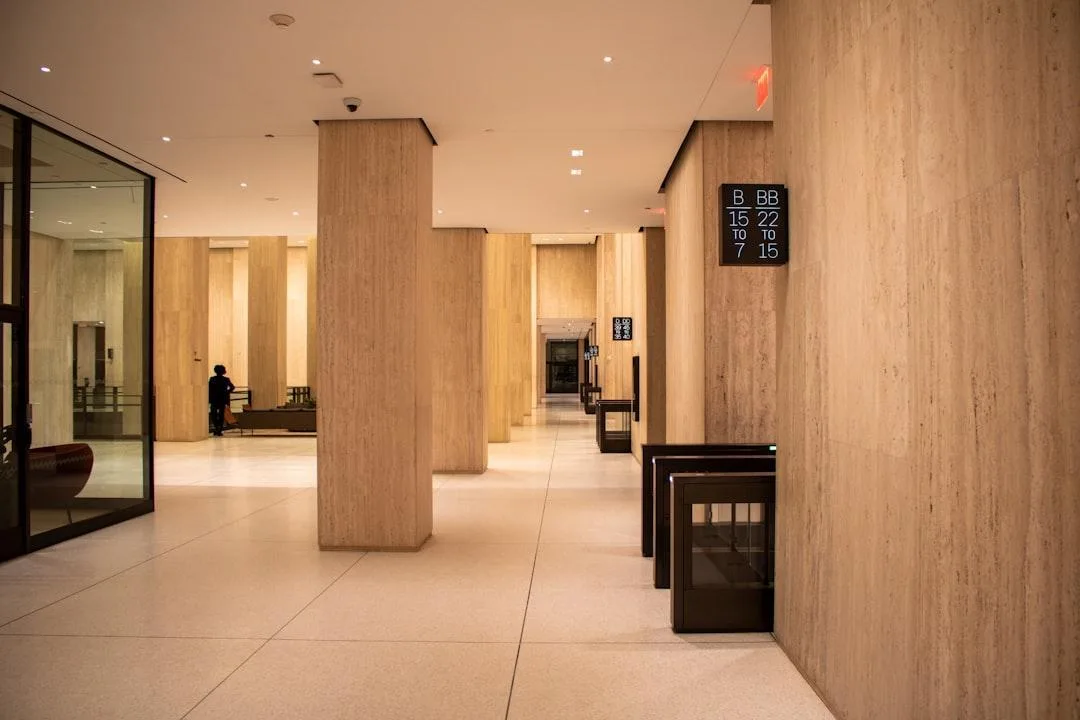
Every corporate lobby entrance operates against two competing requirements. It must move a full shift of employees through a narrow footprint during a compressed morning window, and it must verify that every person passing through is authorized to enter (ASIS International).
Why Peak Load Defines the Design Problem
Lobby entry demand is not distributed evenly across the day. A building housing several thousand employees concentrates most arrivals into roughly a 45 minute window, which means the entrance must be sized for peak load rather than average load.
What Happens When Lanes Are Undersized
Undersized entry points produce queues that spill into the street or the elevator bank. Beyond the visible congestion, queuing creates the conditions where employees prop doors and hold barriers open for one another, which defeats the control the system was installed to provide.
How Optical Turnstiles Balance the Two Requirements
Optical turnstiles use sensor arrays to detect passage and enforce one credential per person while keeping lane geometry open and visually unobtrusive. They preserve architectural sightlines in ways that full height barriers cannot, which is why they dominate Class A office lobbies.
Where Integration Determines Actual Performance
Hardware selection matters less than how the lane integrates with credentialing, and entrance systems designed as a single package spanning turnstile hardware, access control software, and visitor management deliver throughput that piecemeal assemblies of the same components rarely match (SES Integrators).
Why Lane Width Affects More Than Comfort
Lane width determines whether users carrying bags or coffee pass cleanly or slow the cycle. Narrow lanes measurably reduce effective throughput below their rated capacity in buildings where most people arrive carrying something.
How Barrier Speed Interacts With User Behavior
Barriers that close aggressively train users to hesitate, which slows every subsequent cycle. Tuning barrier timing to observed user behavior recovers throughput that hardware specifications alone will not deliver.
Which Variables Actually Drive Lane Count
Four variables determine how many lanes an entrance requires, and building population is only one of them.
- Peak arrival volume within the busiest 15 minute interval
- Credential read time for the badge technology in use
- Percentage of visitors requiring separate processing
- Accessible lane requirements under applicable standards
How Accessibility Requirements Shape the Lane Bank
Accessible routes require a minimum clear width of 32 inches at doorways under federal accessibility standards (ADA Standards for Accessible Design). Entrance banks therefore include at least one widened lane, which must be positioned so it does not become the default queue for everyone.
Why Wide Lane Placement Matters
A widened lane placed at the natural traffic path attracts general traffic and becomes congested. Placing it slightly off the primary flow keeps it available for the users who actually require it.
What Life Safety Codes Require of Any Barrier
Any barrier positioned in a means of egress must permit free egress under life safety requirements (National Fire Protection Association). This is a design constraint rather than an optional feature, and it governs how turnstile arms behave on alarm or power loss.
How Fail-Safe Behavior Is Verified
Fail-safe operation is confirmed through commissioning tests rather than product literature. The relevant question is what the barrier physically does when the fire alarm activates and when building power drops.
How Visitor Processing Affects Lane Math
Visitors cannot use employee credentials, so every entrance serving visitors needs a parallel processing path. Facilities that route visitors through the same lanes as badged employees create the queue they installed turnstiles to prevent.
Why Pre-Registration Shifts the Load
Pre-registration moves visitor processing off the critical path by issuing credentials before arrival. The visitor still passes through a lane, but the identity verification work happens ahead of the morning peak rather than inside it.
What Commissioning Should Verify
Commissioning tests should measure actual throughput under simulated peak conditions rather than confirming that each lane powers on (ASIS International). A lane bank that passes component testing can still fail to move the population it was sized for.
Why Credential Recertification Matters
Perimeter and lobby systems both benefit from periodic review of who still holds active credentials. Access rights accumulate quietly as people change roles, and recertification is the only reliable way to remove what is no longer needed.
How Contractor and Vendor Traffic Is Handled
Buildings receive recurring vendors who are neither employees nor one-time visitors, and treating them as either creates friction. A recurring-visitor credential class handles this population without permanent badge issuance.
Why Recurring Vendors Deserve Their Own Class
Processing the same cleaning crew as first-time visitors every night wastes time on both sides. A time-limited recurring credential removes that repetition.
How Tenant Turnover Affects Lobby Systems
Multi-tenant buildings cycle occupants continuously, and each move requires bulk credential changes. Systems supporting tenant-level administration let building management delegate that work rather than absorbing it.
What Visitor Kiosks Contribute at Peak
Self-service visitor kiosks move identity capture off the reception desk and let one host handle several arrivals. They perform best when pre-registration has already collected the visitor details in advance.
Why Kiosks Still Need a Staffed Fallback
Visitors without pre-registration, or with names that do not match records, require a person to resolve the exception. Kiosks reduce staffed volume rather than eliminating the position.
How Lobby Acoustics Affect Turnstile Areas
Hard-surfaced lobbies amplify the mechanical sound of barrier operation across a bank of lanes. Acoustic treatment near the entrance improves the experience without affecting throughput at all.
Why Sound Becomes Noticeable at Volume
A single lane cycling is inaudible while eight lanes cycling continuously through a morning peak is not. The condition only appears once the bank is operating at full load.
How Elevator Dispatch Interacts With Lobby Flow
Destination dispatch systems assign elevators at the turnstile rather than at the elevator bank, which moves a queue from one place to another. Coordinating the two systems prevents solving lobby congestion by relocating it.
Why Integration Timing Matters Here
Credential data can drive both entry and elevator assignment from a single badge read. Buildings that plan that integration during design avoid the duplicate interaction that retrofits usually produce.
What Turnstile Lane Length Contributes
Longer lanes give sensors more passage to evaluate and reduce false rejections, while shorter lanes conserve floor area. The tradeoff is a real one and should follow from lobby depth rather than from a catalog default.
How Short Lanes Affect Detection
Compressed detection zones give the sensor array less data per passage, which raises both false accepts and false rejects. Lobbies forcing short lanes should expect to tune more aggressively.
Why Signage Reduces First-Time User Friction
Visitors approaching an optical turnstile for the first time often hesitate about where to present a credential. Clear reader marking eliminates a pause that compounds into visible queuing at peak.
What Effective Marking Looks Like
Illuminated reader targets and directional indication resolve most hesitation without written instruction. The cue has to be visible from several feet back to change approach behavior.
How Retrofit Projects Constrain Lane Layout
Existing lobbies rarely offer the floor depth new construction can allocate, and structural columns frequently sit where lanes would go. Retrofit design works around fixed conditions rather than optimizing from scratch.
The Practical Design Sequence
Entrance design works backward from peak load and code requirements, not forward from a product catalog. Establish throughput and egress requirements first, and the appropriate hardware configuration follows from those numbers.